Blake Snyder published Save the Cat! in 2005. It became the most read screenwriting book in Hollywood, and also, among more literary-minded writers, the most mocked. Neither reaction is useful. The beat sheet is a tool. It rewards knowing what it is actually for.
This article goes deep on the 15 beats: what each one does mechanically, why it exists structurally, and where most writers misapply it. If you want the overview, the story structure templates guide has that. This is the practical detail that overview could not hold.
What Is the Save the Cat Beat Sheet?
The beat sheet is a structural template that divides a standard 110-page screenplay into 15 named beats, each assigned approximate page numbers. It is more granular than three-act structure and more prescriptive than the Hero's Journey.
The name comes from a screenwriting principle Snyder describes in the book: give your protagonist an early moment where they do something likeable (like saving a cat) so the audience has a reason to root for them before the story gets difficult. The principle extends to the whole template. Every beat is designed with audience psychology in mind, not just story logic.
The page numbers are targets, not laws. A low-budget indie can run 90 pages. A prestige drama might run 120. Scale proportionally. What matters is the sequence and the relative weight of each beat.
Why Screenwriters Keep Coming Back to It
Three-act structure tells you what to write: setup, confrontation, resolution. The beat sheet tells you when to write it and what each moment should make the audience feel. That level of detail is why it sticks around.
Act Two in a three-act outline spans roughly 60 pages. That is half the screenplay and the vaguest instruction. "Protagonist faces escalating obstacles" could describe anything. The beat sheet cuts Act Two into six distinct sections with different jobs, different tones, and different relationships to the central theme.
For genre screenwriters especially, that precision is a gift. Commercial audiences have internalized genre rhythms without knowing it. They feel when a film is running long before the midpoint, when the "fun" stretch has overstayed its welcome, when the finale is arriving too quickly. The beat sheet is a map of those ingrained expectations.
It is also an excellent diagnostic tool for revision. When a script is not working and you cannot pinpoint why, mapping your scenes against the 15 beats will often show you where the structural contract with the audience has been broken.
The 15 Beats, Explained
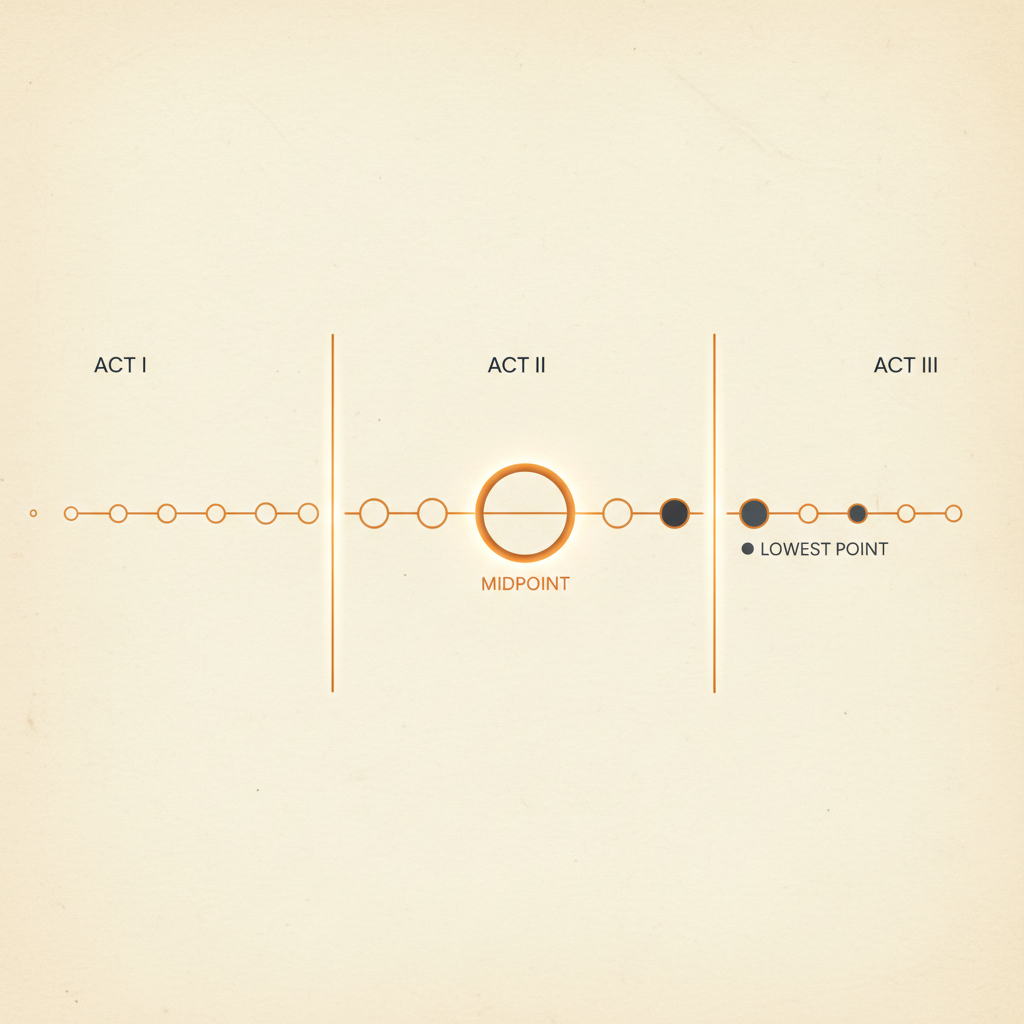 The 15 beats laid out across three acts. The midpoint sits at the center of Act II. The dark node near the end of Act II marks the "All Is Lost" moment, the lowest point before the finale.
Opening Image (p. 1)
The opening image is a snapshot of your protagonist's world before the story begins. It should be visually specific and emotionally telling. Not a summary of backstory. A single image that captures the emotional state or life condition that is about to change.
In Get Out, the opening image is a Black man walking alone through a white suburban neighborhood at night, uncomfortable and surveilled. It establishes tone, threat, and racial anxiety in one sequence, before we meet the protagonist or learn the plot.
The opening image works in tandem with the final image. They are bookends. Whatever the final image shows, the opening image should show the opposite (or the same thing, made strange by everything that happened in between).
Theme Stated (p. 5)
Around page 5, someone states the film's theme, almost always obliquely, often directly to the protagonist. The protagonist usually does not understand it yet, or dismisses it. The audience may not catch it on first viewing. But it is there.
In Ratatouille, the theme ("anyone can cook") is stated early and literally, but the protagonist has not yet tested it against reality. The rest of the film is the protagonist learning whether the theme is actually true.
The theme stated beat is often the most misunderstood. Snyder does not mean you write a character who announces the moral of the story. He means you plant a question or assertion that the entire plot will proceed to examine. The protagonist proves or disproves it by the finale.
Setup (pp. 1-10)
The setup overlaps temporally with the opening image and theme stated. It is less a discrete moment than a sustained section: the first ten pages establish who the protagonist is, what their life looks like, and crucially, what is missing or broken about it.
Snyder's shorthand is "the six things that need fixing." Identify the protagonist's flaws, habits, and relationships that are not working. These are the things the story will disrupt and, if it is a positive transformation arc, correct. In The Matrix, the setup shows us Thomas Anderson: bored cubicle worker by day, hacker by night, searching for something he cannot name. The six things that need fixing are all there. His passivity, his isolation, his distrust, his unfulfilled sense of purpose.
The setup is also where you introduce the genre and tone. Audiences calibrate their expectations in the first ten pages. A thriller that opens like a comedy is not subverting genre. It is breaking a social contract with the viewer.
Catalyst (p. 12)
The catalyst is the inciting incident: the event that kicks the story into motion and makes the protagonist's current life unsustainable. Something arrives, something is discovered, something is lost.
In Bridesmaids, the catalyst is Annie being asked to be maid of honor for her best friend. In Jaws, it is the discovery of a body on the beach. The catalyst does not have to be catastrophic. It has to be irreversible. The protagonist cannot simply return to the status quo and pretend it did not happen.
Note the page count: 12, not 1. The first ten pages do the setup work so that when the catalyst lands, the audience understands what it disrupts. A catalyst without setup is just an event.
Debate (pp. 12-25)
The debate is the protagonist's hesitation. They have been given a call to action by the catalyst, and they are not sure they want to answer it. They ask "should I?" in whatever form that question takes for this particular story.
This beat is frequently rushed or skipped entirely. Writers want to get to the action. But the debate is doing something the rest of the screenplay depends on: it convinces the audience that the protagonist's eventual choice is a real choice, not a foregone conclusion. If there is no genuine hesitation, there is no commitment when the commitment finally comes.
The debate also allows you to show the protagonist's fear, which is almost always the same as their flaw. What they are hesitating about is usually what they most need to confront. In Jaws, Brody knows the beach should be closed. He does not close it. He defers to the mayor, to social pressure, to his own desire to not make waves. That hesitation costs a life, and the cost is what makes his eventual commitment to hunting the shark feel earned.
Break into Two (p. 25)
This is the end of Act One. The protagonist stops debating and acts. They choose to enter the new world the catalyst opened up for them.
The word "choice" is critical. The protagonist must make an active decision. Something happening to them is not a break into two. The protagonist going somewhere, committing to something, making an irreversible move: that is Act Two beginning.
In The Matrix, Neo swallows the red pill. He has been given a choice. He makes it. Everything before this moment was the old world. Everything after is the new one.
B Story (p. 30)
Five pages into Act Two, a new character enters or an existing relationship deepens. The B story is usually (not always) a romantic relationship, but Snyder's real definition is more useful: the B story is the subplot that carries the theme.
The A story carries the external conflict. The B story carries the internal one. The protagonist is trying to save the world in the A story. In the B story, they are learning whether the theme stated on page 5 is true.
The B story character often functions as a mentor figure, or at least as someone who holds a mirror up to the protagonist. They say things the protagonist is not ready to hear yet.
Fun and Games (pp. 30-55)
This is the longest single section of the beat sheet, and also the most misunderstood name. "Fun and games" does not mean the film should be light or comedic here. It means the film is delivering on the promise it made in the logline.
The audience bought a ticket for a specific kind of story. This is where they get it. A horror film delivers scares. A romantic comedy delivers charm and tension. A heist film delivers the planning and the complications. Whatever made the concept sound interesting, you pay it off here.
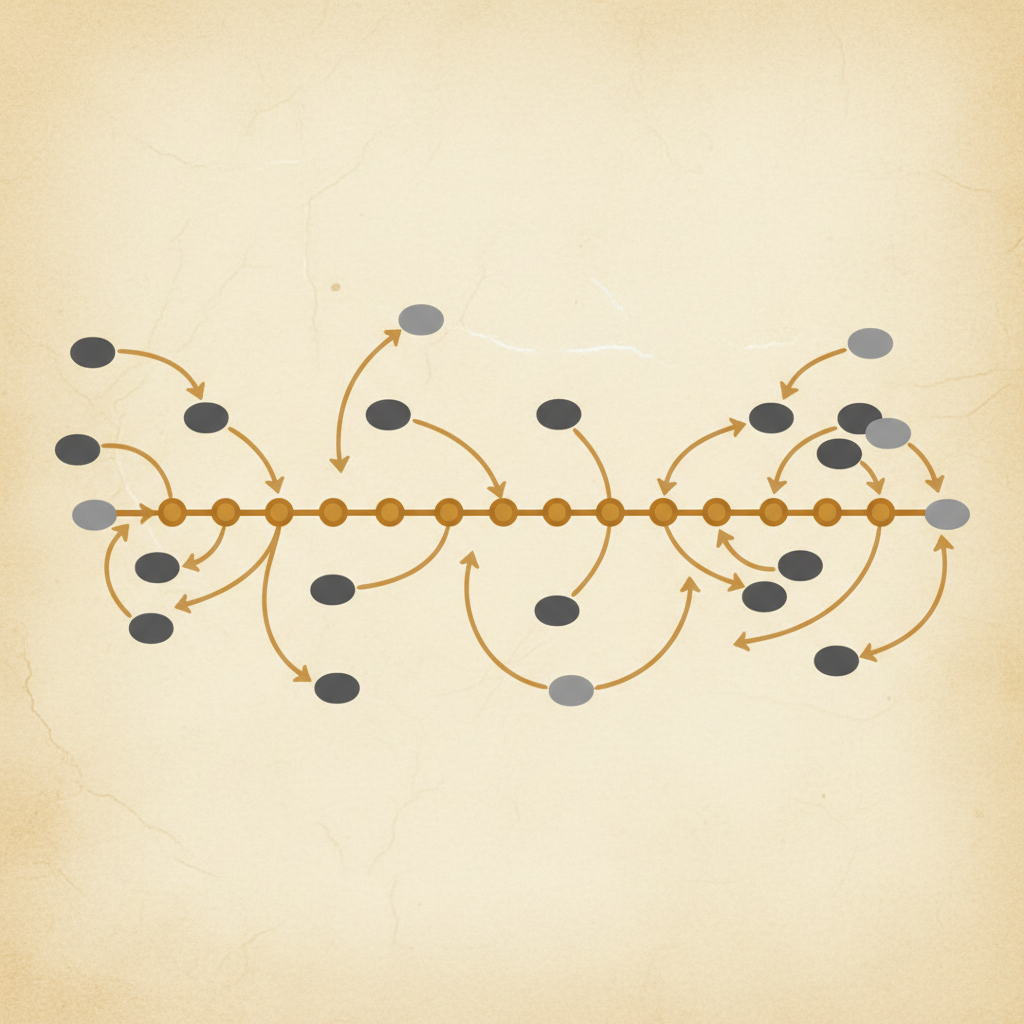 The Fun and Games section up close. Subplot threads branch off the main path and weave back in, delivering on the promise of the premise.
Notice what fun and games is not: it is not escalating toward the climax. The protagonist is often winning here, or at least playing the game they signed up for. The pressure will come. For now, the story is doing what it promised.
Midpoint (p. 55)
The midpoint divides Act Two in half and raises the stakes. Snyder identifies two types: false victory and false defeat.
A false victory looks like success but contains the seeds of later failure. In Toy Story, Woody and Buzz escape from Sid's room, which looks like a win, but the real complications are still ahead. A false defeat looks like failure but actually reveals something the protagonist needs to succeed. In Get Out, the midpoint is the hypnosis scene: Chris believes he is cooperating with a harmless hypnotherapist, but the audience sees how deep the threat runs.
After the midpoint, the stakes are personal. Before the midpoint, the protagonist was pursuing an external goal. After it, they understand what they actually stand to lose.
Bad Guys Close In (pp. 55-75)
External pressure and internal pressure both increase. The antagonist tightens their grip. The protagonist's team starts to fracture. Old flaws resurface. The B story character may pull away.
The "bad guys" are not always human. In a character-driven story, the bad guy closing in is the protagonist's own psychology. Their fear, their addiction, their refusal to change: whatever the flaw was in the setup, it now threatens to destroy everything they have been building.
This section should feel relentless. Every scene should cost the protagonist something.
All Is Lost (p. 75)
The lowest point. The plan has failed. The protagonist has lost something or someone significant. It should feel, genuinely, like the story might not recover.
Snyder notes that many "all is lost" moments involve a death, literal or metaphorical. A mentor dies. A relationship ends. An opportunity is destroyed forever. The point is finality. This is not a setback. It is a collapse.
In Get Out, All Is Lost arrives when Chris discovers the photos and understands the full scope of what has been happening to him. His phone is dead. He is isolated. The audience's dread is at its peak.
Dark Night of the Soul (pp. 75-85)
After the all is lost moment, the protagonist sits with the wreckage. This beat is often truncated or cut entirely because writers confuse it with pacing problems. It is not dead air. It is the moment the protagonist transforms.
The answer to the theme stated on page 5 emerges here, not as a speech, but as a realization. The protagonist finally understands what they were missing, what the story has been teaching them, and what they need to do differently.
In The Matrix, the Dark Night of the Soul is the moment after Neo learns he is not the One (or believes he is not). Everything Morpheus sacrificed, everything the crew risked, was apparently for nothing. Neo sits with that. And in that stillness, something shifts.
Without this beat, the Break into Three feels arbitrary. The protagonist cannot suddenly decide to try again unless something has changed internally. The Dark Night of the Soul is where that change happens.
Break into Three (p. 85)
The protagonist discovers the solution, usually by integrating the lessons of the A story and the B story. The external plan and the internal transformation converge. They know what they have to do and why.
This beat is the payoff of the entire B story. Whatever the B story character was teaching or reflecting, the protagonist finally gets it. Often the B story character (or the memory of them) is what provides the insight. In Toy Story, Woody realizes he and Buzz are not rivals. They are both Andy's toys, and that is enough. The A story (getting back to Andy) and B story (Woody's jealousy and Buzz's identity crisis) merge into one clear purpose.
Finale (pp. 85-110)
The finale executes the solution in five movements Snyder calls "storming the castle": gathering the team, executing the plan, handling the high tower surprise (the unexpected complication), digging deep down (the protagonist's real transformation being tested), and executing the new plan that synthesizes everything learned.
Most weak finales fail at the high tower surprise. The protagonist solves the problem they set out to solve, and that is it. But the most satisfying finales reveal that the real problem was different from the apparent one, and the protagonist's transformation is what allows them to solve it.
In The Matrix, the finale runs all five movements: Neo goes back into the Matrix (gathering the team), fights his way through the building (executing the plan), faces Agent Smith one-on-one when escape seemed possible (high tower surprise), dies and is resurrected by Trinity's kiss and his own belief (digging deep down), and then stops bullets with his mind (new plan). Each layer depends on what he learned in Acts Two and Three.
Final Image (p. 110)
The mirror of the opening image. Same setting, same character, different meaning. Or completely different: a new world that proves the theme.
The final image asks: what has changed? If you cannot identify a visual, specific answer to that question, the screenplay may have not executed a genuine transformation.
Applying the Beat Sheet to a Real Film
Get Out (written by Jordan Peele) maps onto the beat sheet with unusual precision. It is worth walking through because Peele uses the structure to build dread rather than comfort, which answers the common criticism that the beat sheet produces predictable films.
Opening Image: A Black man walking alone in a white suburb at night, uncertain and threatened. The film's central anxiety is established before a word of dialogue.
Theme Stated: Rose tells Chris he does not need to worry about telling her parents he is Black. "They would have voted for Obama a third time if they could." The theme, unstated but implied: the liberal racism that hides behind performative acceptance is as dangerous as overt racism, maybe more so.
Setup: Chris and Rose's relationship. Chris's skill as a photographer. His loss of his mother, unprocessed. His friendship with Rod. The six things that need fixing: his trust in white liberal goodwill, his tendency to stay in uncomfortable situations rather than leave.
Catalyst: Rose invites Chris to meet her parents for the weekend.
Debate: Chris is uneasy. He asks directly if her parents know he is Black. He almost does not go.
Break into Two: They drive to the estate. Chris enters the Armitage world.
B Story: Rod, Chris's friend, who distrusts the situation from the start. Rod carries a version of the theme: survival instincts that Chris has suppressed.
Fun and Games: The estate weekend. The unsettling housekeeper and groundskeeper. The party with the white guests who say strange, fetishizing things about Chris's body. The film is delivering on its promise: sustained, social-horror discomfort.
Midpoint (False Defeat): The hypnosis scene. Missy hypnotizes Chris, ostensibly to cure his smoking. He sinks into the Sunken Place. The audience now understands a threat that Chris does not.
Bad Guys Close In: Chris discovers Logan (a Black man behaving strangely) at the party. He photographs him, the flash breaks through the programming briefly, and Logan warns Chris to get out. Chris tries to leave. Rose delays him. The noose tightens.
All Is Lost: Chris finds the photos. He understands that Rose has done this before, to other Black people. He is trapped, isolated, surrounded.
Dark Night of the Soul: Brief but effective. Chris, alone, processes what he has discovered and what it means. The passive tendency the story has been diagnosing becomes critical: will he stay in this situation or finally act?
Break into Three: Chris decides to leave. The B story, via Rod's persistent calls and warnings, provided the emotional resource. Chris's instinct to survive, suppressed throughout, takes over.
Finale: The escape. The confrontation with each Armitage. The high tower surprise: Rose, who he trusted most, is the most dangerous threat. The resolution of the opening image: a police car arrives, and the dread of the opening sequence returns, until Rod steps out.
Final Image: Chris, alive, in Rod's car, driving away from the estate. The threat is neutralized. The suburb is behind him.
Where the Beat Sheet Falls Short
The beat sheet is optimized for a particular kind of commercial narrative: a single protagonist with a clear external goal and a character flaw that the story corrects. Many excellent films do not have this shape.
Ensemble films distribute the protagonist function across multiple characters. Films with passive protagonists (where events happen to the protagonist rather than being driven by them) resist the beat sheet's insistence on active choice at the Break into Two and Break into Three. Literary adaptations often have thematic ambiguity that the Beat Sheet's "theme stated" beat tends to flatten.
The beat sheet also biases toward external conflict. The B story is meant to carry the internal arc, but in a five-line description, internal transformation is easy to shortchange. Writers who follow the beat sheet faithfully but without understanding its purpose often produce scripts that hit every structural beat but feel emotionally thin. The external events are correct. The interiority is missing.
Use it as a diagnostic tool, not a blueprint. Map your story against it to find where the engine is missing, not to dictate where the engine should go.
Using Visual Plot Mapping with Save the Cat
The beat sheet is a linear list. Reading through 15 beats in order, you understand the sequence. You do not see the relationships.
Consider what the beat sheet is actually doing: the opening image and final image are in conversation. The theme stated and the dark night of the soul are in conversation. The B story's function is to develop the internal arc that the A story cannot carry alone. These are structural relationships, not sequential ones. A list hides them.
When you map the 15 beats as nodes on a canvas, you can draw those connections explicitly. The opening image and final image become linked nodes. The theme stated links to the dark night and the break into three. The B story character connects to every beat where the internal arc shifts. You see the architecture of the screenplay rather than its timeline.
Scyn is built for exactly this kind of work. Instead of checking beats off a list as you outline, you build them as a connected structure on a canvas. You can drag the midpoint and watch which beats it has relationships with. You can see whether your B story is properly woven through the fun and games section or isolated from it.
The visual canvas also makes it easier to spot missing beats at a glance. A node with no connections is a structural orphan. A beat that connects to nothing else in the story is often a beat that is not doing its job.
For deeper context on visual outlining methods, the visual plot mapping guide covers the underlying principles in more detail. For building any beat-sheet-style outline, the screenplay outlining guide covers the full process from logline through scene breakdown.
The Beat Sheet as Starting Point, Not Destination
The screenwriters who get the most out of the beat sheet understand why each beat exists, not just where it falls. The beat sheet is a model of how audiences experience story time. It maps when expectation, tension, relief, and transformation tend to land.
When you understand the mechanics, you can violate them intelligently. You can push the catalyst to page 20 if you have a specific reason for the extended setup. You can skip the B story if your protagonist's internal and external arcs are unified. You can run two simultaneous fun and games sections if your structure supports it.
The writers who get into trouble with the beat sheet are those who treat it as a contract. They hit every beat in order and cannot understand why the script still feels mechanical. Structure is necessary but not sufficient. The beats have to be inhabited by specific, irreplaceable characters making specific, irreplaceable choices.
The beat sheet gives you the skeleton. What goes on those bones is still your problem.