The fastest way to waste six months on a screenplay is to start writing pages before you know where the story is going. Every working screenwriter has learned this the hard way at least once. You get to page 45, realize your second act has no engine, and either push through into a draft you will have to gut-renovate or abandon the project entirely.
Outlining is how you avoid that. Not because an outline locks you in, but because it forces you to solve structural problems when they are cheap to fix: before you have written the dialogue, the action lines, the scene transitions you are proud of and will resist cutting.
This is a practical process for getting from a raw idea to an outline you can actually write from.
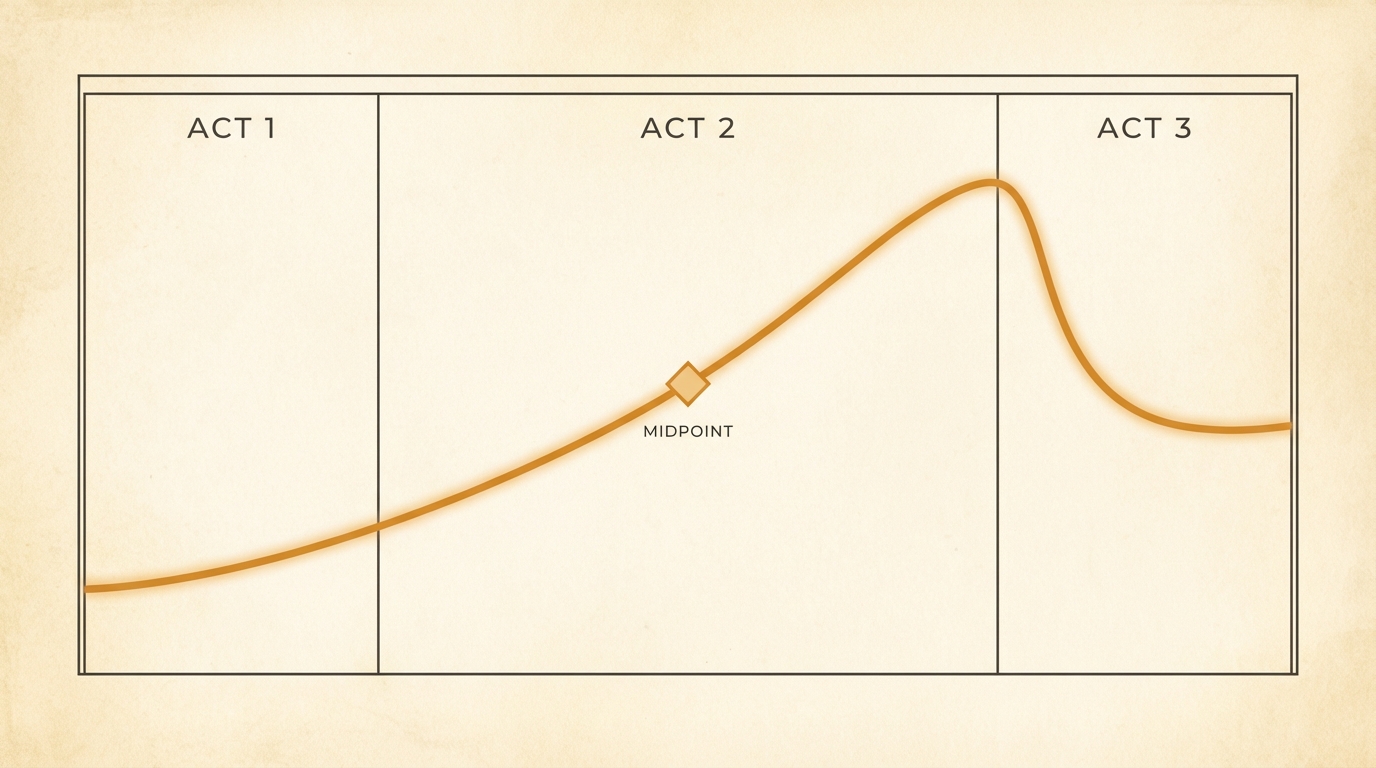 Three-act structure with tension curve. Act 1 sets up the world, Act 2 builds through the midpoint to maximum tension, Act 3 resolves it.
Start With the Logline
Before you outline anything, you need to be able to describe your movie in one or two sentences. This is your logline, and it is doing more work than you think.
A strong logline contains a protagonist, a central conflict, and stakes. "A retired hitman must come out of retirement when a mob boss's son kills his dog" tells you the character, the problem, and why it matters. If you cannot write a logline, you do not have a story yet. You have a setting, or a character, or a vibe. Those are starting points, not stories.
Write the logline first. Rewrite it until it is sharp. If the logline is boring, the movie will be boring. Fix it now.
The Premise Paragraph
Expand your logline into a short paragraph covering the beginning, middle, and end. Three to five sentences. This is not a synopsis for a producer. It is for you, to confirm you actually know how the story resolves.
Most screenwriters find the first act easy to describe. Then the paragraph trails off: "and then things get complicated and eventually there is a confrontation." That vagueness is a red flag. Push through it. Name the complications. Name the resolution.
Breaking Into Acts
Three-act structure is not a rule. It is a default starting point, and it is a useful one because virtually every produced film maps onto it whether the writer was thinking about acts or not.
Act One (roughly pages 1-25 in a 110-page script): Establish the protagonist, their world, and the status quo. Then break it. The inciting incident disrupts the protagonist's life. By the end of Act One, the protagonist has committed to a course of action that will drive the rest of the film.
Act Two (roughly pages 25-85): The longest and hardest section. The protagonist pursues their goal and faces escalating obstacles. The midpoint (around page 55) shifts the dynamic in some significant way, often raising the stakes or revealing new information. Act Two ends with the "all is lost" moment where the protagonist's plan has failed.
Act Three (roughly pages 85-110): The protagonist regroups, makes a final attempt, and either succeeds or fails. The central question posed by the inciting incident gets answered.
These page counts are guidelines, not laws. But if your Act One runs 40 pages, something is wrong. You are spending too long on setup.
Beat Sheets and the Sequence Approach
Once you have your three acts, you need to break them into smaller pieces. There are two popular approaches, and they are not mutually exclusive.
The beat sheet lists the key narrative moments in your screenplay. Blake Snyder's Save the Cat is the most widely known (more on that in our story structure templates guide), but you do not need a specific template. Identify the 12-15 moments where something changes. Each beat should shift the protagonist's situation, knowledge, or emotional state. If a beat does not change something, it is not a beat.
The sequence approach breaks your screenplay into 8 sequences of roughly 12-15 pages each. Each functions like a mini-movie with its own setup, tension, and resolution. Instead of staring down a 60-page Act Two, you are filling in four sequences of manageable length.
Try writing your beats first, then grouping them into sequences. They cluster naturally into mini-arcs.
From Beats to Scene Outline
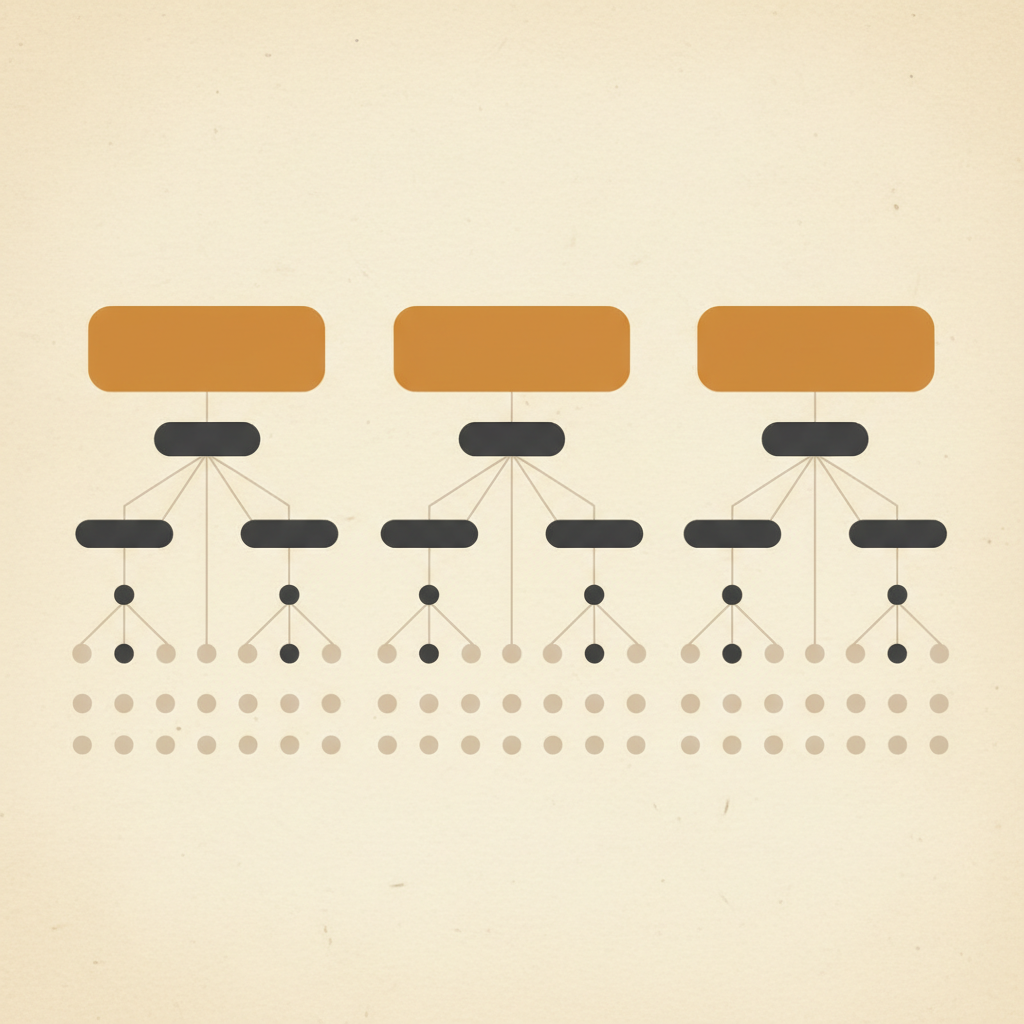 How beats break down into scenes. Each act contains several beats, and each beat can require multiple scenes to dramatize.
This is where the outline starts to look like a blueprint for actual pages. Take each beat and ask: what scenes do I need to dramatize this beat?
A single beat might require one scene or several. "The protagonist discovers the conspiracy" is a beat. But it might play out across three scenes: one where they find a suspicious document, one where they confront an ally who deflects, and one where they break into an office and find proof.
For each scene, note:
- Where and when it takes place (this becomes your slugline)
- Who is in the scene
- What changes by the end of the scene
- What the audience learns that they did not know before
That last point is critical. Every scene should give the audience new information. If the audience knows the same things at the end of a scene as they did at the beginning, the scene is not doing enough work.
At this stage, many writers use index cards, one per scene, so they can physically rearrange the order. The digital equivalent works too. Tools like Scyn let you lay scenes out as nodes on a canvas and draw the connections between them, which is particularly useful when you need to track how information flows between subplots.
Common Outlining Mistakes
Over-outlining. If your outline reads like a prose treatment with dialogue snippets, you have gone too far. Leave room for discovery in the writing. Know the destination of each scene, not every step along the way.
Under-outlining Act Two. Writers tend to know their beginning and ending cold but leave Act Two vague. "Stuff happens, tension builds" is not an outline. This is where most screenplays fall apart, so spend the most time here.
Ignoring the antagonist's plan. What is the antagonist doing while the hero is figuring things out? Outline the antagonist's actions alongside the protagonist's. Their plans should collide.
Confusing activity with conflict. A character drives somewhere, talks to someone, and leaves. That is activity. A character drives somewhere to get something they need, gets refused, and has to make a difficult choice. That is conflict. Every scene in your outline should contain conflict.
When to Stop Outlining and Start Writing
Here is a reliable heuristic: if you can describe what happens in every scene from the inciting incident to the climax, and you understand why each scene follows from the previous one, you are ready to write. You need to know the chain of cause and effect. You do not need every line of dialogue.
The outline is done when it stops feeling productive and starts feeling like procrastination. You will know the difference. Trust it.
The goal was never a perfect outline. The goal was enough structure that when you sit down to write FADE IN, you know where you are going. Pages come faster, dead ends get avoided, and the rewrite becomes refinement rather than reconstruction.